Role: Solo Designer
Date: 2026
Deliverables: Design Challenge Figma File
Scope: AI, B2B
___________________________________________
Context
This case study documents how AI was integrated into the process of completing a product design exercise. The goal is not to explain the product itself, but to show how AI was applied at different stages.
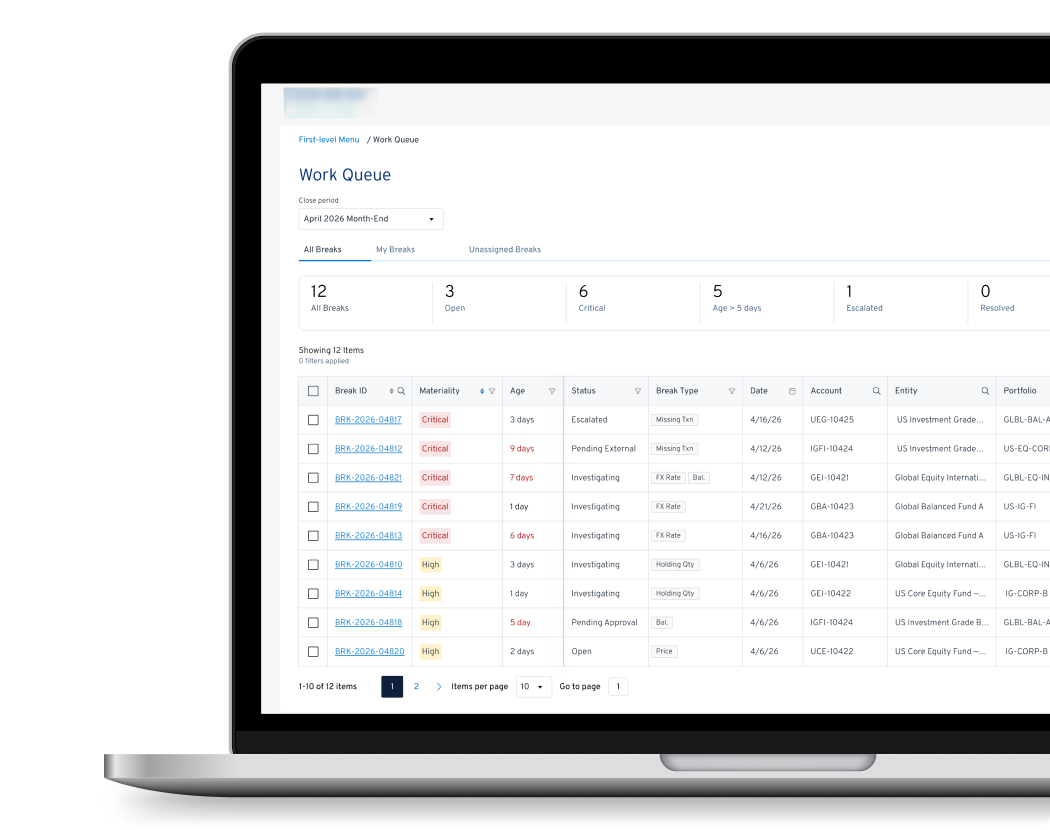
The design brief comes from a B2B SaaS fintech company focused on investment management services. The ask is to design an investment reconciliation workflow for investment operations analyst and investment accounting analyst to resolve discrepancies faster while maintaining strong audit traceability.
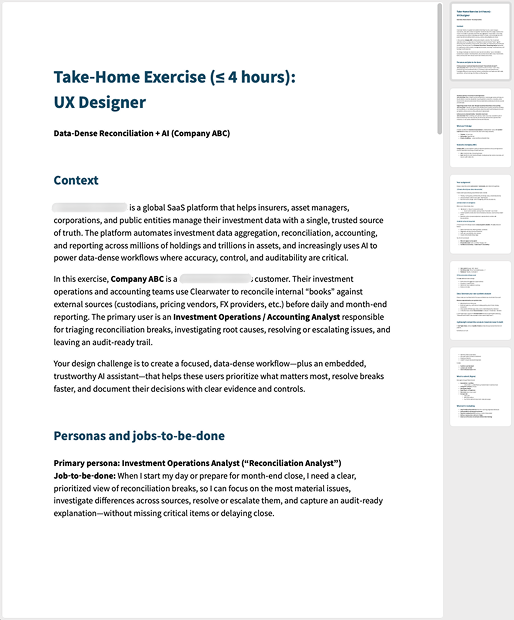
What’s defined within the brief:
personas and their job to be done.
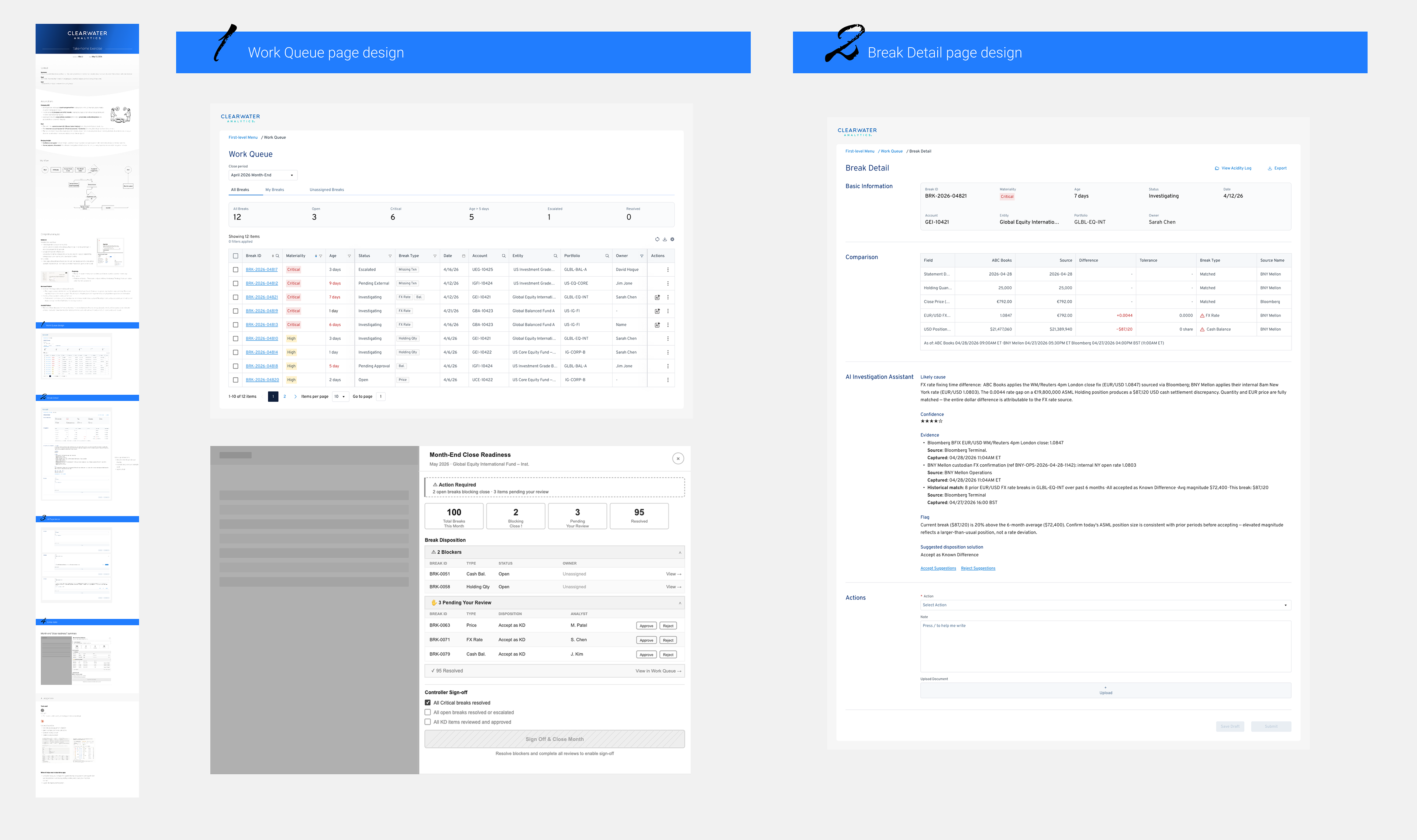
deliverable: work queue page + break detail page
expect time spend on project: 4 hours
personas and their job to be done.
deliverable: work queue page + break detail page
expect time spend on project: 4 hours
___________________________________________
Outcome
___________________________________________
Summary of AI in Design Process

___________________________________________
AI in Discover
Strategy
The domain was unfamiliar. Rather than spending hours reading industry documentation on investment reconciliation, I used AI as an on-demand SME. I asking targeted questions to build up a mental model of the workflow, the data sources involved, and the analyst's daily reality.
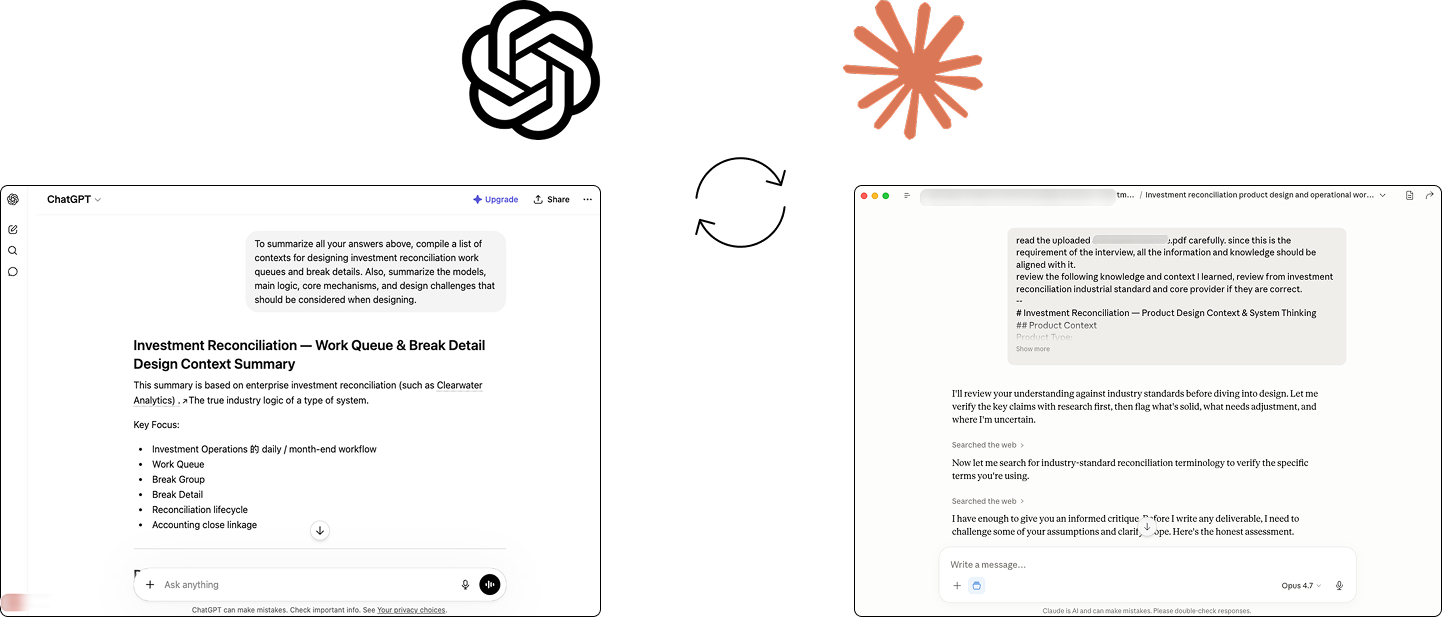
To reduce hallucination risk, I deliberately cross-validated AI outputs: generating a summary from one session, then feeding that summary to a second session and asking it to challenge or correct the content. This back-and-forth helped surface inconsistencies before they became assumptions baked into the design.
The domain was unfamiliar. Rather than spending hours reading industry documentation on investment reconciliation, I used AI as an on-demand SME. I asking targeted questions to build up a mental model of the workflow, the data sources involved, and the analyst's daily reality.
To reduce hallucination risk, I deliberately cross-validated AI outputs: generating a summary from one session, then feeding that summary to a second session and asking it to challenge or correct the content. This back-and-forth helped surface inconsistencies before they became assumptions baked into the design.
What I did
I queried AI to understand: what reconciliation breaks are, how they're classified, what systems are involved (custodian feeds, pricing vendors, FX providers), and what materiality thresholds mean in practice. I also asked AI to generate a reference document that I could use as a design foundation and continuously refer back to.
Outcome
A structured context document covering domain concepts, break types, data sources, materiality thresholds, and severity measurement, providing a factual foundation for all downstream design decisions.
A structured context document covering domain concepts, break types, data sources, materiality thresholds, and severity measurement, providing a factual foundation for all downstream design decisions.
____________________________________________________
AI in Define
Strategy
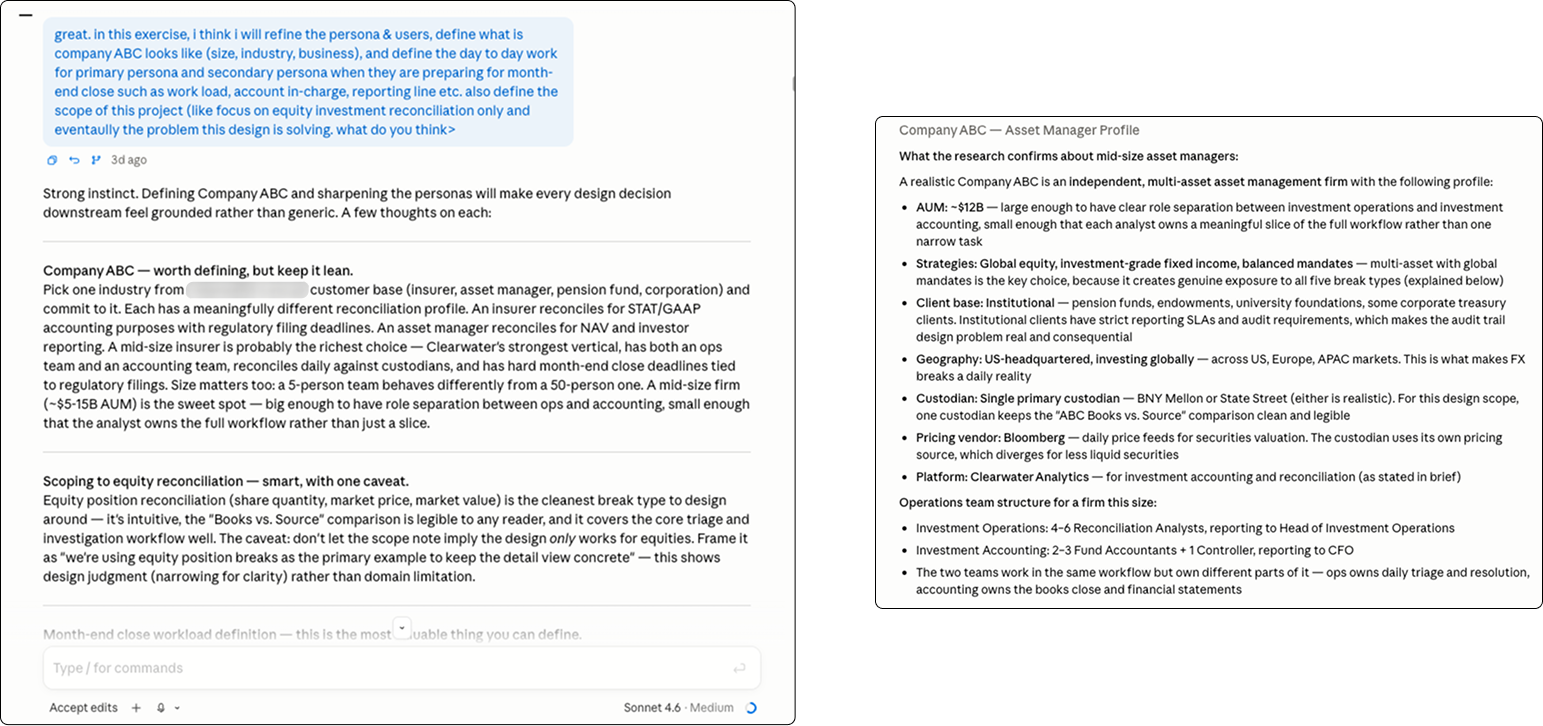
Instead of designing for a generic persona, I wanted the user profile to reflect a plausible real-world firm. My strategy was to use AI as a research assistant to construct a specific, grounded company profile, which would make materiality thresholds, team size, and workflow complexity feel realistic rather than assumed.
What I did
I asked AI to help define a fictional but realistic asset manager: AUM range, team structure, the types of funds managed, and the specific pressures the operations and accounting teams face at month-end close. AI then helped articulate two distinct personas, the investment operations analyst focused on daily break resolution, and the investment accounting controller focused on close readiness and sign-off.
This shifted the design from "solving for a generic analyst" to "solving for someone in a specific role, at a specific type of firm, under specific end-of-month pressure."
Outcome
A user profile with company context (AUM, fund types, team structure) and two differentiated personas, including their goals, and decision-making authority within the reconciliation workflow.
Instead of designing for a generic persona, I wanted the user profile to reflect a plausible real-world firm. My strategy was to use AI as a research assistant to construct a specific, grounded company profile, which would make materiality thresholds, team size, and workflow complexity feel realistic rather than assumed.
What I did
I asked AI to help define a fictional but realistic asset manager: AUM range, team structure, the types of funds managed, and the specific pressures the operations and accounting teams face at month-end close. AI then helped articulate two distinct personas, the investment operations analyst focused on daily break resolution, and the investment accounting controller focused on close readiness and sign-off.
This shifted the design from "solving for a generic analyst" to "solving for someone in a specific role, at a specific type of firm, under specific end-of-month pressure."
Outcome
A user profile with company context (AUM, fund types, team structure) and two differentiated personas, including their goals, and decision-making authority within the reconciliation workflow.
____________________________________________________
AI in Develop
Strategy
In this phase, AI was used to accelerate iteration speed. Instead of generating content and wireframes from scratch, I used AI to produce first drafts quickly, then applied critical judgment to evaluate, question, and redirect.
The goal was to spend less time creating and more time deciding.
What I did
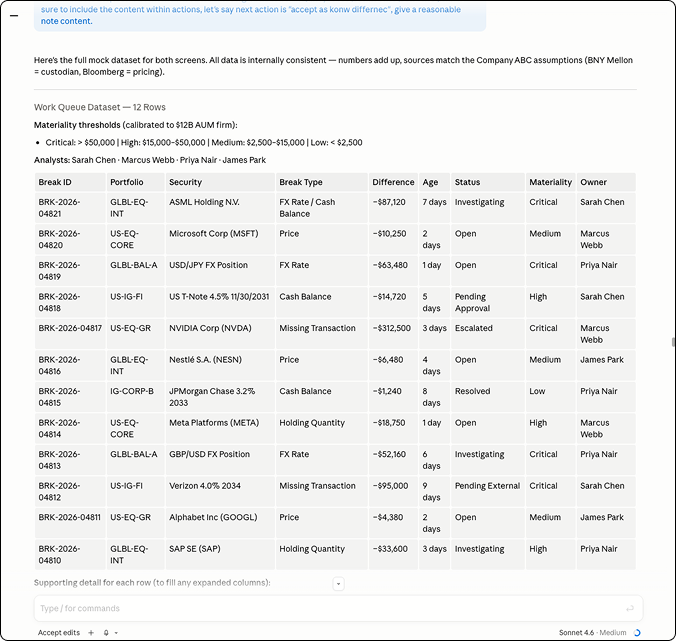
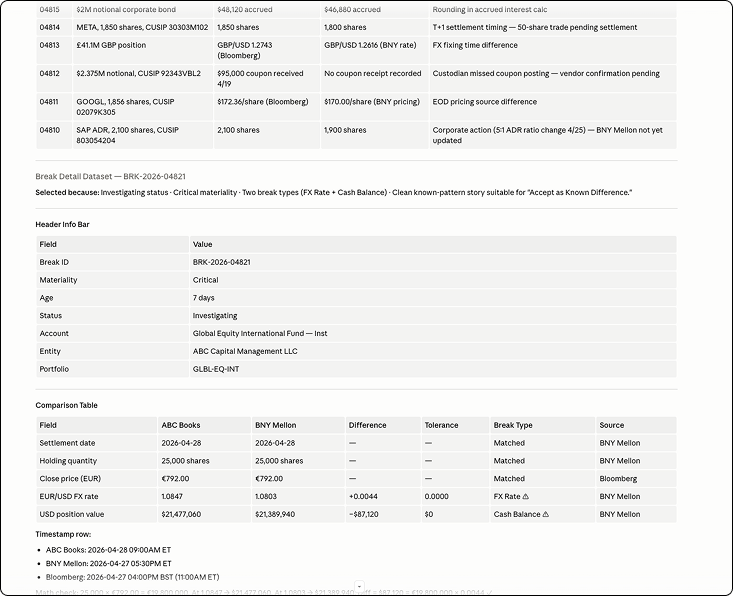
Dataset generation: I directed AI to generate a mock dataset of 12 reconciliation breaks with realistic attributes, includes break IDs, account numbers, entity names, portfolio names, statuses, materiality levels, break types, onwers and different values comparison with root cause.
Rather than accepting the first output, I caught and corrected several domain errors: a custodian name that didn't match the project assumption, a tolerance shown in shares instead of dollars, and a column (Security) that was irrelevant for certain break types. Each correction improved the dataset's credibility.
In this phase, AI was used to accelerate iteration speed. Instead of generating content and wireframes from scratch, I used AI to produce first drafts quickly, then applied critical judgment to evaluate, question, and redirect.
The goal was to spend less time creating and more time deciding.
What I did
Dataset generation: I directed AI to generate a mock dataset of 12 reconciliation breaks with realistic attributes, includes break IDs, account numbers, entity names, portfolio names, statuses, materiality levels, break types, onwers and different values comparison with root cause.
Rather than accepting the first output, I caught and corrected several domain errors: a custodian name that didn't match the project assumption, a tolerance shown in shares instead of dollars, and a column (Security) that was irrelevant for certain break types. Each correction improved the dataset's credibility.
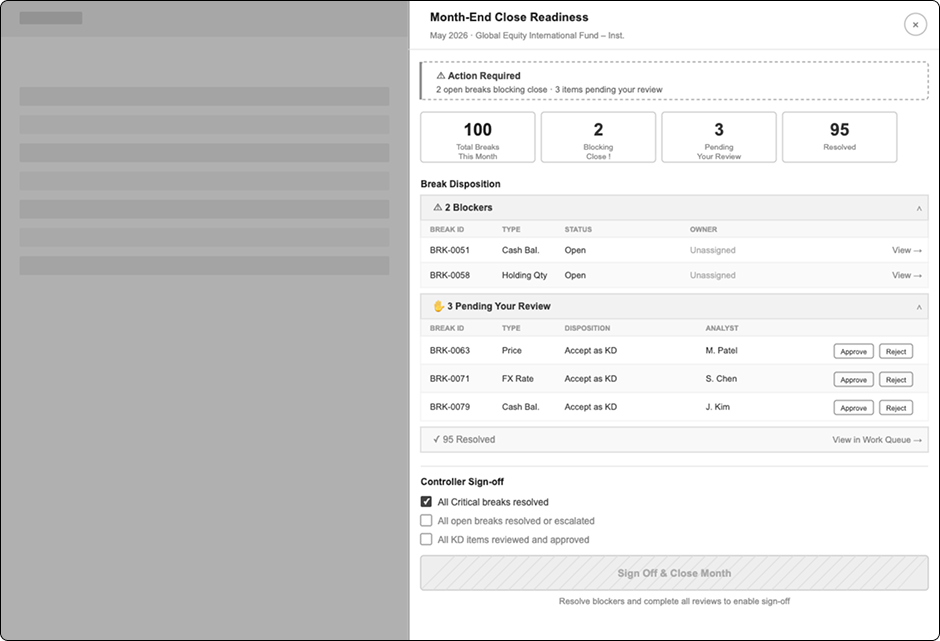
UX decision-making: AI served as a sounding board for interaction design questions — where to place resolution actions, how to handle resolved breaks in the Work Queue, whether month-end close readiness belongs in a full page or a side drawer. Critically, I challenged AI's proposals repeatedly. When a suggested layout caused role confusion between note-taking and resolution actions, I flagged it and asked for alternatives. The final interaction pattern went through three iterations before reaching a structure that made sense for audit requirements.
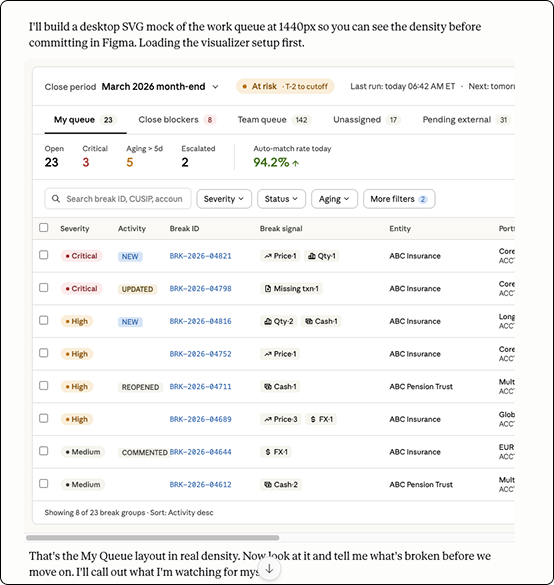
Wireframing: I described screen structures in text, and AI produced SVG wireframes that could be reviewed immediately in a browser. Specific elements such as column layouts, accordion sections, a floating bulk action bar were refined through follow-up prompts.
____________________________________________________